



Mental Balance versus Vocal Balance
Mental activity in singing
Singing involves highly complex mental activity, which may act either as a powerful ally of the singer or as an obstacle that prevents them from reaching their full potential as a performer. Indeed, singing at a professional level is among the most demanding tasks for the human central nervous system, as it requires the combination of complex physical movements that call for the coordination of motor and auditory skills. These skills, in turn, establish multiple connections and interactions between different regions of the brain during practice.
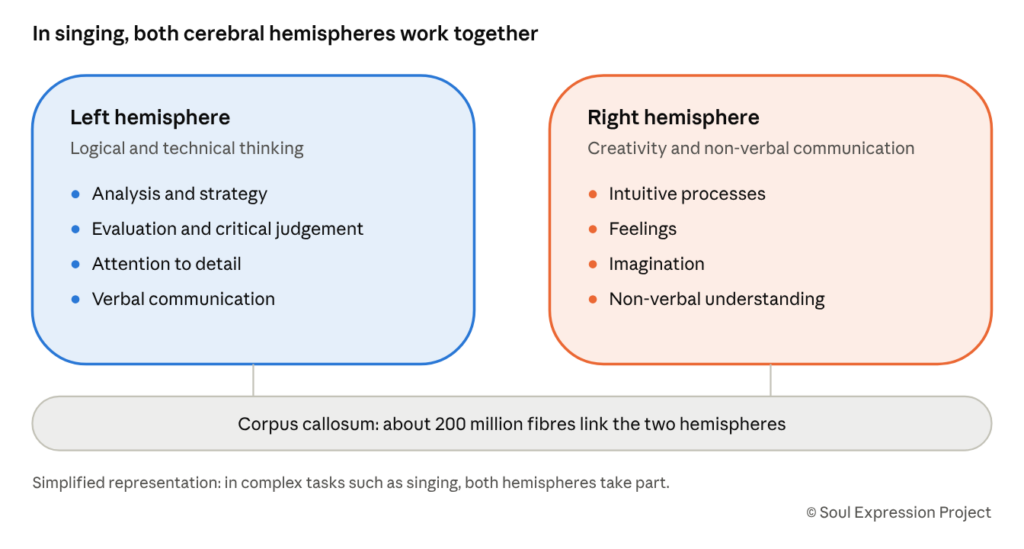
The cerebral cortex, regarded as the most complex organ of the human body, plays a central role in managing cognitive functions. It is divided into two hemispheres, connected by approximately 200 million nerve fibres that make up the corpus callosum.
Singing draws, on the one hand, on logical and technical thinking, traditionally associated with the left hemisphere and, on the other, on creativity and non-verbal communication, traditionally associated with the right hemisphere, so that both hemispheres have the opportunity to participate
. The left hemisphere is chiefly related to analytical thinking, strategy, evaluation, critical judgement, detail and verbal communication; the right hemisphere, to intuitive processes, feelings, imagination and non-verbal understanding (Fig. 1). The challenge facing the singer is therefore to make the most of their mental activity in performance.
Mental attitude as a tool
Successful performance is usually accompanied by a confident and optimistic attitude, inner calm and a high degree of concentration. Conversely, when negative thought patterns prevail, the risk of physical tension increases and concentration diminishes, compromising the performance.
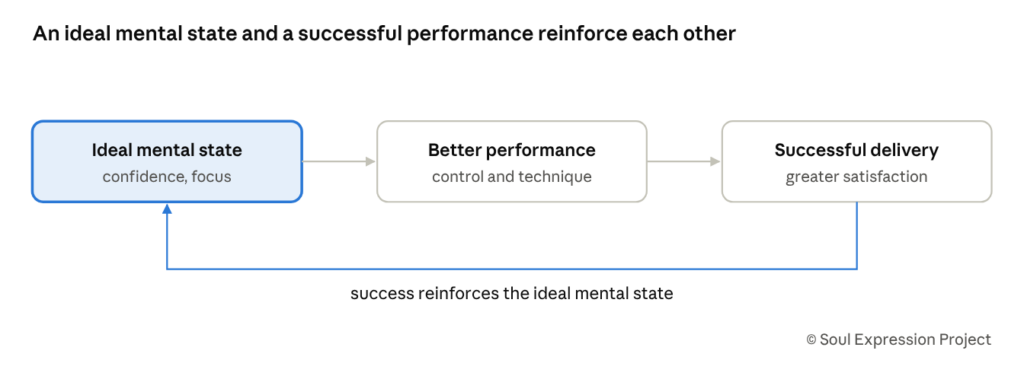
A positive thought pattern makes it easier for the singer to feel in control of their technique, to relax physically and to remain highly aware of their own body and surroundings. This state results from the balance between the physical body, the mental dimension and technical rigour, three inseparable aspects of any performance (fig. 2). In Power Performance for Singers, the authors state:
“The higher your level of physical well-being and your mastery of the vocal, musical, linguistic, and dramatic skills, the more control you have over your performance. However, the higher your level of physical and technical skills, the more important the mental aspects become.” (Emmons & Thomas, 1998, p. 12)
The same authors list the psychological characteristics that make it possible to achieve a high level of performance (Emmons & Thomas, 1998, p. 14) (fig. 3):
- No feelings of fear
- An ability to regulate anxiety and arousal during performance
- Maintenance of positive thoughts and imagery throughout performance
- High confidence that is unshakable
- An ability to remain focused and concentrated, without distractions
- Determination to succeed
- Thinking that is committed and disciplined
- Control over the performance.
The singer should therefore become aware of their thought patterns. The physical and technical control exercised throughout a performance depends, to a large extent, on the psychological and emotional environment to which the singer is subject. An “ideal” mental state promotes better performance and, reciprocally, the success of a performance reinforces that same mental state (fig. 2).
Strategies for fostering an “ideal” mental state in performance
The authors identify a set of desirable skills for achieving this state: clear and specific planning, together with the goals to be attained; building self-confidence; managing levels of mental energy; valuing innate and/or acquired abilities; balancing personal and professional life; enjoying each moment of performance and its preparation; persistence; focusing on the present moment (avoiding the fears associated with past experiences or concerns about future possibilities); and refraining from judging the performance while it is under way.
All of these aspects point to a resilient attitude, refined day after day with control and consistency, in technique and artistic mastery as well as in mental skills. Approaching each situation as a challenge rather than a difficulty or a threat, minimizing errors and distractions, and drawing the maximum learning from a weaker performance all strengthen the singer’s mental resilience. Consistent practice of this attitude strengthens motivation and makes the singer more positive, while remaining realistic about their abilities. It also brings greater emotional control (states such as anger, frustration or panic are less likely to interfere with performance), a calm and relaxed attitude (in which pressure is seen as a challenge rather than a threat), greater powers of concentration, greater control over and responsibility for one’s own actions, determination to succeed and the ability to maintain high levels of mental energy. For the singer, these characteristics represent an opportunity to deepen self-knowledge and to learn how to deal with oneself.
a) Self-confidence
Positive thinking is one of the most powerful skills and tools available to the singer. Confidence stimulates positive emotions and thoughts and, conversely, performance reflects, if inadvertently, the singer’s inner attitude, behaviour and self-perception. Even with a sound technical command and a good level of physical well-being, a lack of confidence in the quality of one’s vocal delivery will show in the performance.
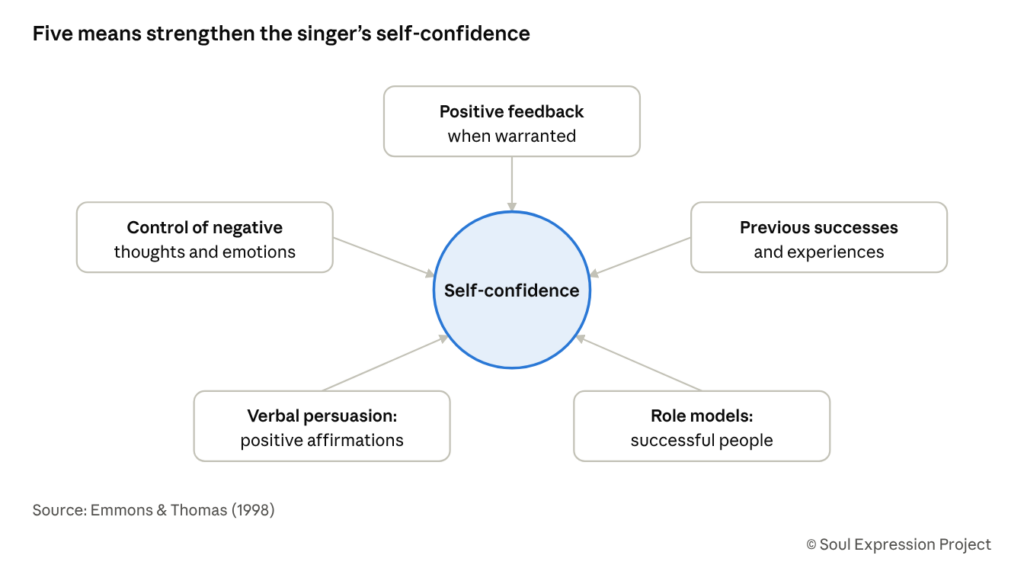
How, then, can the singer gain and strengthen self-confidence? Emmons and Thomas (1998) point to five means (fig. 3): (1) interaction with people who are able to give positive feedback when it is warranted; (2) a focus on previous successful performances and experiences; (3) contact with successful people who can serve as role models; (4) verbal persuasion, capable of changing attitudes and behaviours that lead to self-confidence; and (5) the ability to control negative thoughts and emotions. Verbal persuasion rests on adopting positive affirmations that lead to this state of self-confidence, that is, affirmations that value the singer’s positive characteristics, traits and skills and that confirm their strengths, qualities and abilities, both mentally (consciously and subconsciously) and physically.
b) Distractions
In performance and in practice sessions alike, certain factors that give rise to distraction can undermine vocal efficiency. Situations that provoke anxiety, nervousness or fear may disturb mental focus and, consequently, vocal execution and production. Being aware of what the focus should be at each moment of the performance makes it possible to pay less attention to distracting factors.
Among the factors that most frequently lead to distraction are (fig. 4):
- unfamiliar physical spaces, since size, acoustics or lighting can be negative factors;
- internal physical reactions, triggered by nervousness or anxiety, such as sweating, trembling, palpitations or a dry mouth;
- the audience, which may include a panel of judges (in the case of an audition), other singers, teachers, coaches, conductors or agents.
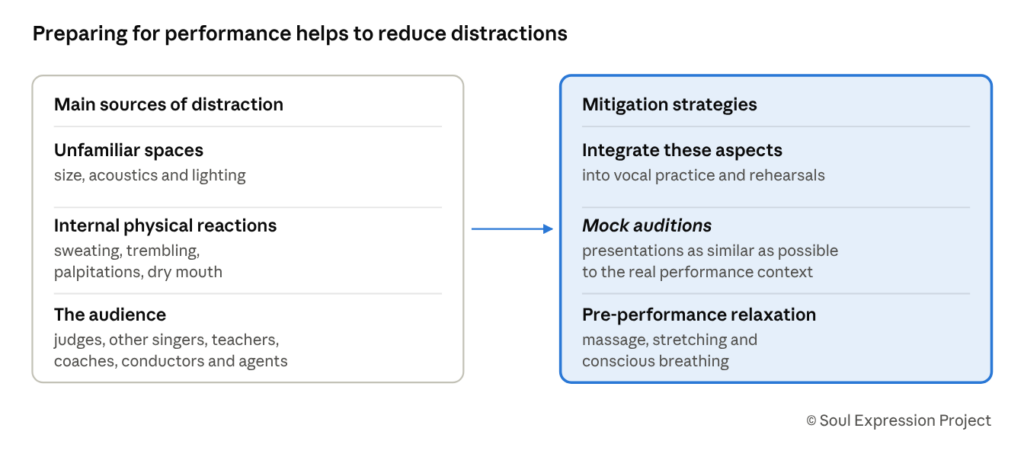
The following strategies can help to reduce sources of distraction: integrating these aspects into vocal practice and rehearsals and becoming aware of them; giving presentations that resemble the real performance context as closely as possible (mock auditions); and including pre-performance relaxation strategies, such as massage, stretching and conscious breathing.
c) Concentration
Concentration is also a fundamental parameter in the relationship between mind and vocal outcome, and it is essential to define the goals to be achieved during practice. The following strategies may help to increase concentration and, consequently, to obtain better results:
- focusing attention on the physical sensations produced by applying the technique, creating mental images that evoke those sensations;
- performing a piece or excerpt without value judgements during practice, allowing the performance to flow instinctively and naturally;
- practicing under conditions similar to those perceived in an earlier performance regarded as successful;
- practicing for short periods of time, fully immersed in the sensations and the goals to be achieved.
Applying these strategies contributes to a more relaxed state, free of undesirable tension, as well as to greater mental clarity.
Conclusion
Professional vocal performance requires mastery of motor skills and the recognition of behavioural patterns, which involve a complex set of perceptual and cognitive operations taking place in the central nervous system. The plasticity that characterizes it allows it to adapt to the demands of professional vocal performance over prolonged practice. Indeed, singing, when carried out continuously, can induce a reconfiguration of neural networks, involving the activation of nerve cells and contributing to the modulation of the functional organization of hearing, as well as of sensory and motor patterns and visual representations. Through their learning focus, singers can thus create new patterns that lead to different performance outcomes and, consequently, to greater satisfaction with their delivery.
References
Emmons, S. & Thomas, A. (1998). Power Performance for Singers. New York: Oxford University Press.
Green, B. (2015). The Inner Game of Music. London: Pan Books.
Parncutt, R. & McPherson, G. E. (2002). The Science & Psychology of Music Performance. New York: Oxford University Press.